Author Archives: admin

The following stories may be short, but they tell a tale about the times when we are living. They are stories that don’t necessarily build our faith in humanity but rather, they tear it down.
I’m sure that you will get a laugh from the following stories. It’s not only because they are ridiculous, it’s because they just might be true and more than likely, you’ve seen it for yourself.
My husband and I went through the McDonald’s driveway window and I gave the cashier a $5 bill.
Our total was $4.25, so I also handed her 25c.
She said, ‘You gave me too much money.’
I said, ‘Yes I know, but this way you can just give me a dollar back.’
She sighed and went to get the manager who asked me to repeat my request.
I did so, and he handed me back the 25c, and said ‘We’re sorry but we don’t do that kind of thing.’
The cashier then proceeded to give me back 75 cents in change.
Do not confuse the people at MacD’s.
—–
We had to have the garage door repaired.
The repairman told us that one of our problems was that we did not have a ‘large’ enough motor on the opener.
I thought for a minute, and said that we had the largest one made at that time, a 1/2 horsepower.
He shook his head and said, ‘You need a 1/4 horsepower.’
I responded that 1/2 was larger than 1/4 and he said, ‘NOOO, it’s not. Four is larger than two.’
We haven’t used that repairman since…
—–
I live in a semi-rural area.
We recently had a new neighbor call the local city council office to request the removal of the DEER CROSSING sign on our road.
The reason: ‘Too many deer are being hit by cars out here! I don’t think this is a good place for them to be crossing anymore.’
—–
IDIOT SIGHTING IN FOOD SERVICE.
My daughter went to a Mexican fast-food place and ordered a taco.
She asked the person behind the counter for ‘minimal lettuce.’
He said he was sorry, but they only had iceberg lettuce.
—–
I was at the airport, checking in at the gate when an airport employee asked,
‘Has anyone put anything in your baggage without your knowledge?’
To which I replied, ‘If it was without my knowledge, how would I know?’
He smiled knowingly and nodded, ‘That’s why we ask.’
—–
The pedestrian light on the corner beeps when it’s safe to cross the street.
I was crossing with an ‘intellectually challenged’ co-worker of mine.
She asked if I knew what the beeper was for.
I explained that it signals blind people when the light is red.
Appalled, she responded, ‘What on earth are blind people doing driving?!’
She is a government employee…..
—–
When my wife and I arrived at a car dealership to pick up our car after a service, we were told the keys had been locked in it.
We went to the service department and found a mechanic working feverishly to unlock the driver’s side door.
As I watched from the passenger side, I instinctively tried the door handle and discovered that it was unlocked.
‘Hey,’ I announced to the technician, ‘it’s open!’
His reply was, ‘I know. I already did that side.’
Let that sink in!

And here is the Truth

Yep

I think KFC has nailed it”
– Change name to ‘KaiFC’ for the month
– Incorporate Maori designs in their logo
– Draw a moko on the Colonel Subtle,
respectful and inclusive 10/10

This is a good idea

Yes

The real (fake as fuck) Racists

The forgotten story of NZ’s Pakeha Slaves
The forgotten story of NZ’s Pakeha Slaves
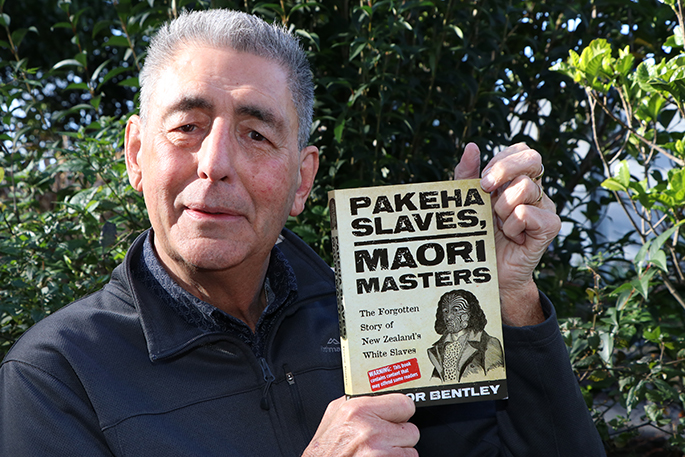
Trevor Bentley with his book that has been red-stickered. Photo: Daniel Hines
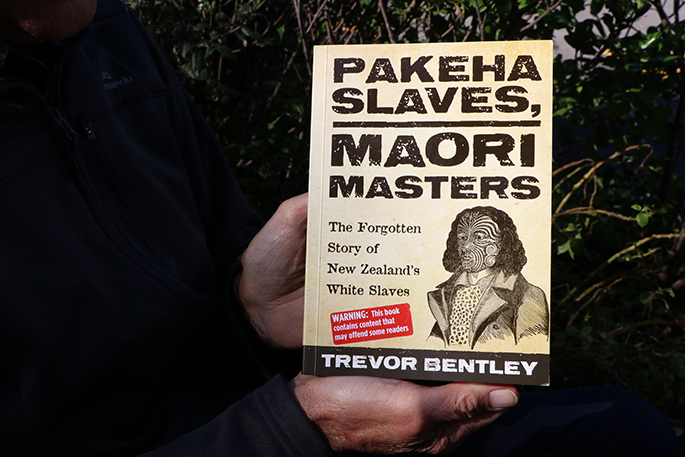
There’s a red warning sticker on the front of Trevor Bentley’s latest book.
Prepare to be offended.
Trevor Bentley, who has a PhD in history, is the first NZ historian to have a book red-stickered. His newly published work ‘Pakeha Slaves, Maori Masters: The Forgotten Story of New Zealand’s White Slaves’ has thrown a strong light on the mostly forgotten story of the Europeans who lived and sometimes died as slaves in tribal New Zealand between the 1790s and 1880s.
“I wrote it to be non-biased, pretty balanced and non-judgemental, but it was still red-stickered,” says Trevor. “I think that’s a result of the current preoccupation we have with hate speech in the wake of the Christchurch massacres.
“I’ve always been fascinated by that very colourful and turbulent pre-treaty of Waitangi interaction between Maori and Pakeha,” says Trevor, who has written three books based in that period of time – ‘Pakeha Maori’, ‘Captured by Maori’ and ‘Cannibal Jack’.”
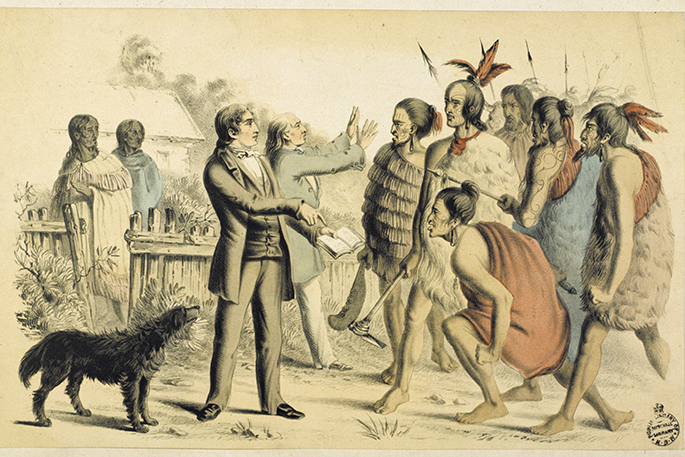
‘Missionaries Henry and William Williams and a muru-plundering party’. Vassal Pakeha who failed to comply with tikanga Maori were ritually plundered by their masters and no exceptions were made for the missionary leader Henry Williams and his brother William (shown). Image credit: Artist unknown, ‘The Power of God’s Word’, 1856, PUBL-0151-2-013, Alexander Turnbull Library, Wellington.
Trevor has had a long-standing interest in the interaction of Maori and Pakeha in pre-Treaty New Zealand and the Europeans who entered Maori tribal societies voluntarily and involuntarily. He has done significant research on New Zealand history pre-Treaty of Waitangi, and on “culture crossers”.
“Other books have focused on the positive aspects of trading and intermarriage, but this one is a bit more hard-hitting,” says Trevor.
“The main people Maori took as slaves were the mariners who were often no better than pirates. There were also hundreds of runaway sailors and escaped convicts from Sydney who were welcomed in to Maori communities. Many of them were very belligerent hard men. Maori regarded then as being uncouth and uncultured. They refused to assimilate, committed crimes and insulted the chiefs, so were enslaved and put to work.
“Community service if you like, for their misdeeds.”
“They were given a few rights, but they were still tribal property or property of the Chiefs. There were also missionaries, shore-based whalers, timbermen or sawyers, and flax traders. They were certainly welcomed in to the Maori communities, given access to resources and protection and got on very well with Maori as long as they contributed. As long as they paid trade goods or reciprocated on a regular basis, then all was fine, but if not then they were plundered.
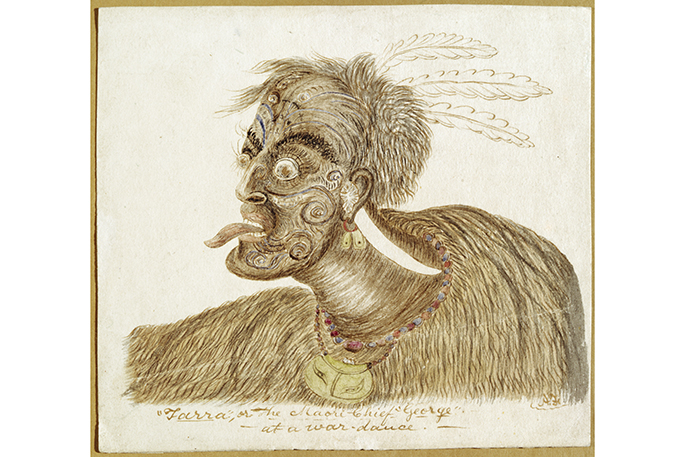
‘The Chief Te Aara of Ngati Uru, Whangaroa’. Image credit: H. Augustus Florence, ‘ “Tarra”, or the Maori Chief “George” at a war- dance’, A-114-002, Alexander Turnbull Library, Wellington.
“Probably the most famous incident was Caroline Perrett, who, at age eight was kidnapped by Maori in Taranaki in 1874, and discovered living as a Maori in Whakatane fifty years later. She was kidnapped because her father had dug up some Maori graves and because Europeans had kidnapped a local Maori child. There is a book about that kidnapped Maori child called “The Fox Boy.’ He was raised by William Fox who later became NZ premier.”
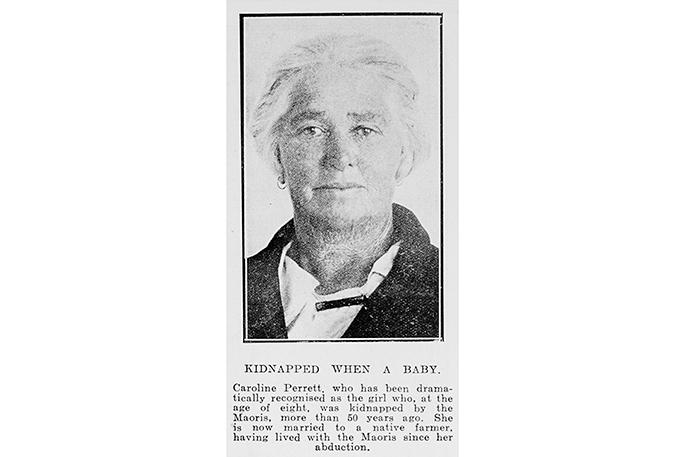
Newspaper clipping of Caroline Perrett’s discovery
Trevor’s book is fascinating, examining and exploring the diverse backgrounds and roles performed by European slaves, their sale prices and the immediate and long term physical and psychological effect of their servitude.
Trevor has extensively researched published histories by hapu and iwi historians and writings on customary law by Maori scholars, also captivity narratives by returned Pakeha slaves, and contemporary accounts about white slaves in newspapers, journals, letters and logs.