Maybe heifer? Or lardo? What about hippo?

by Cameron Slater on January 11, 2018 at 7:30am

A clothing designer is struggling for a replacement label for sizes like extra large:

An Auckland woman was inspired to design activewear to boost women’s self esteem after eight years in the police force.

Jamie Best had worked with victims of domestic abuse and although she felt she was making a difference, she wanted to change people’s lives.

She decided a good way to do it was through fitness.

One day at her desk, she came up with the name Fit N It for an activewear clothing line and went from there.

The Taupaki resident said it was all about being able to “fit in it” and “feel fit in it”.

Her activewear line ranged in size from 6 up to 22 – what she called the cute curves collection.

Why should a woman be called an extra large?

I’ve never liked the sizing guides of judging someone an extra large,” she said.

“It’s been hard because you still have to specify in there roughly the size but I’m trying to change that and get rid of it all together.”

Maybe heifer? or lardo?

“The input of the mums has been really good for making sure that things are designed to fit bigger ladies,” the 28-year-old said.

The waist bands on Fit N It leggings were higher than most and able to cover stomachs. Crop tops were suitable for breastfeeding.

Best said there wasn’t a lot of activewear available for plus-sized women.

Does she mean fatties?


Kiwi fashion designer Sera Lilly said more brands needed to cater for people of all sizes.

She said it was important that plus-sized women had the options available to make them feel good about what they were wearing – including activewear.

A bigger person wants to look just as good as a size 10,” she said.

However, it wasn’t enough to just stop at a size 22.

She said New Zealand had a large population of Māori and Pacific Islanders who were built bigger.

Clothing needed to be available in sizes for everyone, Lilly said.

Rubbish. Hasn’t she heard of the no tights on fatties rule? A enormous fat person is never going to look just as a good as a size 10. No matter what they wear they will look like 13lbs of shit in an 8lb bag.

Maybe she could hire Rachel Smalley to assist in sizing descriptions.

Or go for animal descriptions…hippo, rhino, elephant, whale…

In case you are wondering why a person with the finely tuned body of an athlete (Russian shot-putters are athletes), like myself, can comment…well…I’ve spent almost the entire summer showing off my keg. I simply fail to see why anyone would want a six pack when they can have a keg. Plus, you need a big hammer to drive a long nail. Basically I don’t give a shit, I’m happy…and I don’t care what you may think about my keg. If I want to iron my shirts with a wok that is my business. I certainly won’t be fooling myself thinking I can look like some boy half man with a waxed chest and a six-pack.


-Fairfax

Note.

What about OB size (obese)

Yet another example that proves the UN isn’t fit for purpose

by Cameron Slater on January 10, 2018 at 8:00am

Tony Ellis, lawyer to ratbags

A ratbag in prison has found himself a crusading lawyer who has run off to the UN to get a verdict, despite said ratbag requesting the time in solitary himself:

In 2000, inmate John Vogel was confined to a cell for drug offending; he asked for 21 days – six days longer than legally allowed – to help him deal with his addiction.

Vogel’s lawyer Tony Ellis lodged a complaint with the United Nations Committee in 2015 after a series of legal setbacks in New Zealand.   

An advance copy of the committee’s decision provided to Dr Ellis has found the solitary confinement contravened international human rights law.

The committee ruled the punishment was disproportionate, particularly given Vogel was known to “be suffering from chronic depression and that he had a drug addiction”.

It noted that Vogel was kept in his cell for 23 hours a day with just one hour set aside for exercising and showering.

“He had no access to radio or television … he had no right to make telephone calls or receive visitors.”

The Crown argued that the confinement was at Vogel’s request and the conditions were humane.

The UN committee urged the government to provide “fair and adequate compensation, including the means for as full a rehabilitation as possible” and to report back within 90 days.

How does get fucked sound?

This tosser requested the time in solitary confinement, was duly provided it, and now is whinging that he was tortured…oh puuuuulease.

A fair and adequate compensation would be say $100 per day, less board and supervisions…oh look he owes the taxpayer a couple of grand.

Of course the ratbag wants more than that.

Dr Ellis said he believed it was the first victory any New Zealander had achieved before the committee.

He said Vogel was “very pleased” and hoped he might be permitted day-release as part of his rehabilitation.

Dr Ellis said $10,000 to $20,000 would be a reasonable sum of compensation.

The decision runs counter to the High Court and Court of Appeal which both found the punishment did not amount to torture or cruel treatment.

In 2004, the High Court accepted that Vogel should not have been confined for 21 days, but ruled it did not breach his rights as Vogel had requested the length of time and there was no evidence it had caused him pain or suffering.

In 2013, the Court of Appeal said Vogel’s request was irrelevant and found he had not been treated with humanity or respect. However it declined to go any further or award compensation.

A year later, the Supreme Court tossed out an application for a further appeal, prompting Dr Ellis to go to the UN Committee Against Torture.

Dr Ellis said the UN committee’s decision should act as a wake-up call for New Zealand’s courts.

“This shows that the Supreme Court simply got it wrong – as did the courts below.”

No they didn’t. The UN is not fit for purpose. The courts got it right, and the UN has no jurisdictions, so he can get fucked.

What is delicious though is this happened under Helen Clark’s government and now Jacinda Ardern’s gets to fix it.

Vogel was sentenced in 1988 to life in prison for murdering Peter Hoey in Auckland.

He was released on parole after a decade, but was recalled to prison in January 2000 after further offending.

Vogel is currently in Auckland South Corrections Facility.

He should be in a  box, and the government should ignore the numpties at the UN.


-Radio NZ

No hope for freeloaders with an entitlement mindset

by SB on January 1, 2018 at 1:00pm


Guest Post:

We have to dismantle our social welfare system because it is fundamentally flawed.

Welfare in New Zealand is no longer a safety net but has become a web of destruction for families.  The worst affected are vulnerable children and teenagers.

New Zealand is ignominiously in first place in the developed world for teenage suicide.  We also have one of the highest rates of child abuse in the developed world and one of the worst rates of child death by maltreatment within the family.

It is no coincidence that 16% of our children live in jobless households putting us third highest in the developed world.

We know that sole parenthood and long-term welfare dependency are two of the most serious risk factors for children.


We also know our current welfare system is not moving enough able-bodied beneficiaries off welfare and into work.

Welfare was designed in 1938 by Richard Seddon’s Labour government to ensure every New Zealand family achieved a minimum standard of living following the Great Depression of the 1930s.

Interestingly at that time, we had a “make work” scheme in place whereby work was provided to the unemployed on government projects during the depression.

The depression days are long gone but welfare dependency remains a way of life for our third generation welfare dependent families.

Advocates of welfare-dependents rail against labelling them freeloaders saying they are decent people who just need a hand up.   This ignores the lack of self-worth that keeps them on welfare and can only be addressed by taking individual responsibility for becoming a contributing member of the community.

It’s all about the mindset.  A flawed mindset of entitlement has been passed on to successive generations of freeloaders.

And we, the hardworking members of our community are subsidising a welfare system that is working against us as a nation.

Instead of being the ambulance at the bottom of the cliff our welfare system is a bus full of freeloaders heading off the cliff into despair, depression, teenage suicide and child abuse.

Our welfare system does not give hope to children born into this cycle of dependency.

We like to think our education system is picking up the slack for dysfunctional families by teaching children skills to succeed in life.  It isn’t.

No matter what our educationalists say, they cannot redress the problem because they are not family.  A child learns from their family not by what the adults around them say but what they do.

A child of a single mother will become a single mother herself despite sex education in schools if this is the only family model she knows.

It will be harder for a child of welfare to gain the life skills necessary to achieve employment if there are no working role models in the family.

The two parent family in New Zealand has fewer children than the welfare dependent family because the cost and time required to prepare their children for adulthood is well recognised by hardworking parents wanting a future for their children.

Until we address the poor family model supported by our welfare system we will continue to see New Zealand lead the developed world in child abuse and teenage suicide statistics.

We need to dismantle the welfare system to give our children a hope and a future.

The unemployment benefit should be phased out.  “Make work” schemes similar to the 1930s should be implemented and run by the government or private enterprise or both.

In practice, removal of benefits would require a huge step up from food banks and relief agencies as benefits were phased out.  This alternative support network would operate out of charity not entitlement.

It’s also time to disincentivise solo parent families by phasing out the domestic purposes benefit.  Although we are accustomed to the solo parent family research proves a child does better with two parents.

The goal is to replace the mindset of entitlement with a mindset of hard work and charity.  That is, if you are able to, you should work.  You work to support your family and also help those around you in need.  This is charity.  It builds community.

Then we come to state housing.  Implemented in 1905 as a subsidy for workers dwellings it has morphed into heavily subsidised housing.

In Auckland we saw protests from Glen Innes residents asked to move out of their state-funded homes, now sitting on prime real estate, by government agencies needing to free up cash to accommodate more families needing housing.

These beneficiaries believed they were entitled to live in a community of their choice even though they were not financially paying their way.  Another example of the entitlement mentality we have fostered.

As Auckland groans under the weight of insufficient housing, it becomes a financial reality that housing needs to be further out.

After all, if working families can’t afford to live in Glen Innes why should the beneficiary who is living off their taxes?

If you’re able-bodied but haven’t worked in, say, three years and are living in a state house you should be moved to a satellite city outside Auckland where we can affordably accommodate you.  You will get a roof over your head but it won’t be on prime real estate.

The “make work” schemes would not predominantly be in Auckland central.  Better to site them in cities and towns with affordable housing.

If you are a beneficiary and you know welfare benefits would be being phased out in a few years you’d have to seriously consider getting a job, where you could live and the number of children you could afford.

Take a look at the UK, a society very generous with welfare handouts and a magnet to third world migrants.  If the generational welfare burden was not enough it is now collapsing under the socio-economic burden of EU-mandated-migrants.  Could this be us in 20 years?  Undoubtedly, unless we do something about it.

Suze

About them Maori: and Prison

by Cameron Slater on December 30, 2017 at 9:30am

Guest Post

To follow up on commenter George’s interesting post Thursday on the prickliness of confronting Maori under-achievement in our society (it’s real, and particularly sharply pointed in imprisonment statistics) and the uncomfortable aspersions cast upon those with whom we choose to disagree with, inter-alia, those who don’t hold our identical world-view. It is a polarising debate, and becoming more polarising.

In order to find answers in a neutral setting I summoned my two daughters to me; both entirely beautiful part-Maori maidens, it must be said, and proud of it. Let’s call the older one Mother because she has produced two of the most wonderful grandchildren ever to grace Christendom, while the other we shall call Troubles because she has produced, uhm…never mind.

I advanced them a question, asking if either of them had ever been colonised; both looked slightly shocked. Mother insisted it wasn’t so, while Troubles announced that although she had never been colonised, she had been tattooed, and offered to show me the artwork. I declined the invitation.

Because colonisation of these wonderful islands by the British has been offered as a reason for the decline in mauri and mana, the life-force and respect, of the existing inhabitants subjected to the new pressure from overseas and the waves of alien people thence, a whole new species. A whole new world.

Certainly; it is completely true that the leadership of the colony were extremely concerned at massive loss in numbers and morale of these, their fellow British subjects, and instituted an inquiry as early as 1856 in order to advance both reasons for the decline and counter-measures to inoculate the native people from further destruction.

Counter-measures, some of which were already taking place before the inquiry, included land ownership reformation, political representation, education in the new languages and sciences, provision of health services and sanitation, and, recognising the native bent for horticulture as evidenced by the very first British and European voyagers here, expansion of existing crop varieties and the introduction of mills and other machinery to improve farmed produce and yield.

Another thing happened in 1856; Charles Darwin was penning his masterpiece “On the Origin of Species”, his theory of natural selection that would prove revolutionary and, literally, re-shape world-views. Within fifty years both the dwindling Maori and ‘science’ would reach new lows. Science spun off into fields unsuited to empiricism, especially the fields of eugenics and phrenology, and philosophically into theories of racial superiority and the inevitable replacement of ‘lower’ genes by the ‘higher’.

By the early part of the 20th Century it can be said, with complete honesty, that our people and society were the most institutionally-racist they would ever be, not at all as bad as some of the other colonies; no way. But we were convinced of the superiority of the new sciences and introduced way-of-life in these lands, and the almost inevitable erasure of Maori.

Concerned for racial and social indicators of criminality, a stain our fore-fathers struggled to comprehend in the land of milk-and-honey, officials experimented with statistics to find trends which may alert to the likelihood of social precursors pointing to later imprisonment, and they found an alarming co-relation: There was one group of subjects who, though numbering just 15% of the population represented an unhealthy 33% of the prison muster. Those people were Roman Catholics: No other cohort came close to the unsatisfactory statistic, including Maori, whose numbers incarcerated were wholly in keeping with the general ratio of the non-Maori non-Catholic populace.

A short period later almost the entire world experienced a cataclysmic wrench from the old philosophies, the destruction of the last vestiges of feudalism and monarchal alliances which threw their subjects against each other in hatred and war, and the emergence of new social and political orders. Within a decade the continuing repercussions of war and the false hope of endless gains from imagined wealth culminated in financial calamity when banks collapsed, taking their depositor’s money with them, and ordinary folk; business owners and mortgage-holders found it impossible to re-finance loans resulting in some of the most serious financial hardships seen in the 20th Century. Who would have believed, twenty years before, that Cuba St in Wellington, our capital city, would witness a food riot in 1932?

Dominion Newspaper 1932, a photo of the riots in Wellington


The pains of hunger, the scars of real poverty never left many who experienced the sensations. My own mother would discard neither a newspaper, a potato sack, nor an ice-cream stick, while a sometimes-visitor to our home, an American woman, would not waste an envelope, preferring to steam it open, turn it inside-out and re-use it for new mail. They were proud penny-pinchers whose capability for austerity was astonishing by our modern standards but which asset was honed into them in the bleakness of those years. The penal statistics went steadily along recording, not in total disregard to the social circumstances which produced rioting, stealing, destruction of property and other ‘crimes’, but in attempting to find anomalies, of which there were no particular stand-outs. By 1934 neither Maori nor the previously troubling Catholics were over-represented in prison cells.

Those years of hunger and going-without produced new politicians and causes, and the shaping of a new working-class family; one who would never suffer the indignity, the utter, burning, shame of Want with no means to quench it. Social Welfare was born, it was generous when required to be, and benevolent, non-denominational and ‘universal’ although, by modern standards, slightly racist and sexist.

Another terrible conflict passed and New Zealand suffered in parallel with our partners, but on returning to peace there was much to do, work for all, progress to be made as well as money from shipping exports to a re-building world. Wool prices went so high many youthful immigrants found gainful employment on local farms gleaning strands of the golden fleece from fence-posts and gates. Maori too, embraced and exploited the opportunities available, becoming staples of the wool-sheds and freezing-works, many moved into cities to be closer to high-paying jobs in local ‘manufacturers’ production facilities.

New Zealanders embraced under the Fifties-follies fortunate rainbow. We loved Maori; they loved us. We schooled together, played footy together, partied together, and searched the endless rows of “Situations Vacant” columns in the newspapers together to find the highest-paying jobs. It continued for years and years, right through the sixties, and then it all went pear-shaped.

Mother Britain, who had given us birth, who we had suffered for and stood with, kicked us out of home. We had to stand on our own two feet, she said. And we were not well-placed to do so.

Years of austerity had produced flinty thrift, years of excess has produced trifle smugness. No more could we walk from school to a job as effortlessly as going to bed. The numbers collecting Unemployment benefits, which had been paid to about 450-odd souls in 1974, doubled, then re-doubled then re-doubled then re-doubled, and within ten short years had reached 53,000, but even that number was a facade. Muldoon, a socialist fool masquerading as anti-communist, a financial peon fighting a formidable array of ravaging circumstances, had convinced an eager parliament to lower the retirement age to 60 as panacea to the growing number of dole-seekers, affording a minor explosion in numbers of those giving up work to receive the relatively generous pension. Others opted out of work altogether, years without employment had made even more attractive the low-hanging fruit of the Domestic Purposes Benefit, the Invalids Benefit and the Sickness Benefit, all of which numbers more than doubled.

God’s Own Country was in Deep Schtuk. By 1984 our GDP was $34B, but our yearly financial deficit was $2.7B thanks to huge ‘welfare’ bills, a shortfall entirely ‘sustained’ by endless borrowing to fund our ‘egalitarian, equitable’ society. It was the equivalent of borrowing $22B every year, year-in year-out, indefinitely, in modern-day terms and was a seriously dysfunctional and stupid illusion. It had to stop.

Nobody can say, with a straight face, that David Lange intended to hurt Maori; it is impossible to believe that charismatic man harboured ill-will towards any group of people except his political opponents. Very few though estimated his inner courage correctly, believing him soft and corruptible was a major error.  He stood by his man as Roger Douglas, from a communist upbringing, took the shambolic Kiwi shack apart and rebuilt the structure in a much superior way, with hugely improved foundations; but when he was finished there was a lot of the original material left over, and a new word swept the land: Redundant.

That it was Maori upon whom the cuts fell deepest is an undeniable fact. Ill-equipped to progress, mainly through lack of educational achievement, many were bewildered: A punishment employed by those masters of torture, the Romans, where victims were led blind-folded deep into remote forest areas, the ‘wilderness’, and left bound, abandoned to their own devices.

Unemployment hurts. Not like the sharp pain and adrenaline burst of accidentally hitting your own thumb with a hammer, when your blood boils and your eyes focus bright and angry; the pain of unemployment is much worse because it sucks your self-respect and dines on your own dignity, sometimes to the point of debilitation. It can make you hardened and angry; it can arouse violence within you. It is a hateful thing to give, but worse to receive. The shattered storefronts of Featherston St and Queen St during the 1930’s riots remind us of that.

The new generations watched their parents grow disillusioned, some became angry, others indifferent and keen to exploit the veins of welfare to fund alternative life-styles and, in turn, produce their own disillusioned little-ones convinced of neither the value of education, or work. Some Maori leaders took to new means to lift up their people, a Maori ‘revivalist’ or renaissance movement was born, several traditions almost lost were re-cast, some traditions were even invented; the most obvious being the performing, by the Mighty All Blacks, of the ‘Haka’ at home games, a spectacle never observed in this country before 1987. Many of the Maori revivalists were, and remain, widely respected.

Other Maori ‘leaders’ became agitators, belligerent and spiteful and contemptuous. That’s all right. There have been such people since civilisation year-dot; whether in Memphis, Babylon, Rome, London, Munich or Waitangi. They seek to feed off their own imagined infamy, they spurt hyperbole and misinformation; reacting to such rhetoric is an exercise in futility.

But there is still a problem, and it appears to be getting worse.

To recap: During the time of most ingrained and institutionalised, subconscious, racism in this country no more Maori than anybody else were incarcerated. Therefore, can we say, neither racism, nor colonisation attributed to imprisonment numbers? During the era of the most wide-spread unemployment, unrest and grueling poverty in this country no more Maori than anybody else were incarcerated. Therefore, can we say, that financial hardship did not lead Maori to prison in higher numbers? But during the time of greatest access to welfare assistance Maori prisoner numbers have exploded?

Because of low educational achievement, a self-perpetuating millstone around the neck, a veritable and formidable shackle to the ground that restricts sufferers to reaching only the lowest-hanging fruit, and it’s got to stop, along with the acceptance that Maori require a welfare lifeline, and special treatment.

When Cook and his cohort of scientists came to this land they found an intelligent and resourceful people; they were in the business of documenting strangers and were not new to the task. Many on board were veterans of the oceans, and new lands, and had described Aboriginals from many places, Tierra Del Fuego, Japan, Alaska, the Pacific Islands, Australia, America and many more. They didn’t find under-achievers here in any sense except when judged against Christian moral standards.

The Catholic community determined to deal with criminality a century ago and linked the causes directly to illiteracy. They determined that they were as capable as other citizens of conquering the written word and set about it assiduously in the Marist schools, in the churches, and in the homes. Bought up in Wellington’s eastern suburbs, home to many Catholic families, a friend told me of a story in his family about how his grandfather had taught his father-before-him to read while aged about twelve, at home, and that on completing his first sentence, the older man had wept. With pride.

Our educators, but more importantly, our Maori leaders, the real leaders, the political leaders, the team leaders, even the gang leaders, not self-appointed ‘spokespeople’, need to rise up and hammer this message home: That they are equals here, and that every single Maori child in this entire country will read and write by the age of twelve, with no exceptions whatsoever. Just as the Catholic community did.

That will end this unfortunate imprisonment cycle, it will bring more prosperity than any Treaty-settlement or endless welfare can bring and enrich their lives, and ours. This was achieved by the good people of The Society of Saint Mary within twenty years, it can be achieved by Maoridom within the same time-frame.


-idbkiwi
Spot on Lewis, but why did you apologise?

by Cameron Slater on December 29, 2017 at 9:00am

Lewis Hamilton has courted controversy again…as some snowflakes and whoopsies got upset:

Lewis Hamilton has apologised for making “inappropriate comments” about his young nephew wearing a dress.

The Formula One world champion was accused of humiliating his nephew online after he posted a video in which he disapproved of his relative’s choice of Christmas attire, telling him: “Boys don’t wear princess dresses.”

Hamilton has since deleted the Instagram post, which showed his nephew wearing a purple and pink outfit and carrying a pink wand with a heart on it.

He was heavily criticised for negatively stereotyping his nephew on the basis of his gender.

On Tuesday Hamilton told his 5.2 million followers on Twitter that he regretted his “unacceptable” post.

In the video he posted on Instagram, he said: “I’m so sad right now. Look at my nephew,” , as the camera focuses on the boy.

“Why are you wearing a princess dress? Is this what you got for Christmas?” he asks, as the boy nods delightedly.

“Why did you ask for a princess dress for Christmas?” he goes on.

“Because it’s pretty,” the boy replies enthusiastically, waving the pink wand.

“Boys don’t wear princess dresses!” says Hamilton.

The 32-year-old was abroad celebrating Christmas with his family when he posted the video.

In response, Travis Alabanza, a performance artist, had said: “I hope Lewis Hamilton properly thinks and apologises to his nephew for that video.”

Lewis Hamilton did nothing wrong, he was spot on, so why did he apologise?

These whoopsies are precious, proving the point ironically.

Boys don’t wear princess dresses…he was spot on.


-The Guardian

A good judge tells a ratbag she can pay it back or spend Christmas in the slammer

by Cameron Slater on December 23, 2017 at 7:30am

A ratbag who stole money from a granny has been given a choice by Judge Tony Adeane, pay back what she stole or spend Christmas in the slammer:

She stole $1800 from a 91-year-old and wanted to pay her back at $2 a week while she spent $60 a week gambling.

But Judge Tony Adeane wasn’t having a bar of that.   

Ngaire Ries, also known as Ngaire Rowell, appeared in Napier District Court for sentencing on a charge of theft on Friday.

She had been found guilty after a judge alone trial.

On Friday the Judge sounded singularly non-plussed by submissions made by Ries had to probations officers.

He noted that Ries had initially pleaded guilty, then changed her plea to not guilty, then was convicted.

Reports before him said she had declined to participate in restorative justice sessions with her victim, had refused to consent to an electronically-monitored sentence and had advised the probation service she was not guilty.

“She spends something like $60 a week on gambling out of her limited means and she proposes to repay the amount taken by instalments of $2 a week,” the judge said.

That, unfortunately, was not acceptable, to the court he said.

He gave her two options. One was to complete an automatic payment authority from her benefit for $50 a week to the victim, in which case she would be convicted and ordered to come up for sentence if she reoffends in the next year.

The other option was being remanded in custody until the New Year while further reports were completed.

Ries spent a short time in custody before re-appearing and informing the court, through her lawyer, that she preferred the sound of the former option.

Surprise, surprise, given an ultimatum she chose liberty instead of prison.

“If there is any re-offending or in the event that the reparation is not duly paid Ms Rowell will come back to court and is liable to be imprisoned,” Judge Adeane said.

Ries’s offending was against an elderly woman who had been her friend for a very long time.

In November last year the friend gave Ries her bank card and asked her to deposit a cheque. Over the space of just over two hours Ries used the card to withdraw $1800 from the Westpac ATM at the Maraenui shopping centre in Napier.

What a piece of work. She picked entirely the wrong judge to pitch her $2 a week offer to.

Tony Adeane is a good judge who solves a lot of problems. I do hope that he is being cloned, we need more judges like him.

Labour’s child poverty numbers don’t add up, and a little girl waits

by Cameron Slater on December 16, 2017 at 9:00am

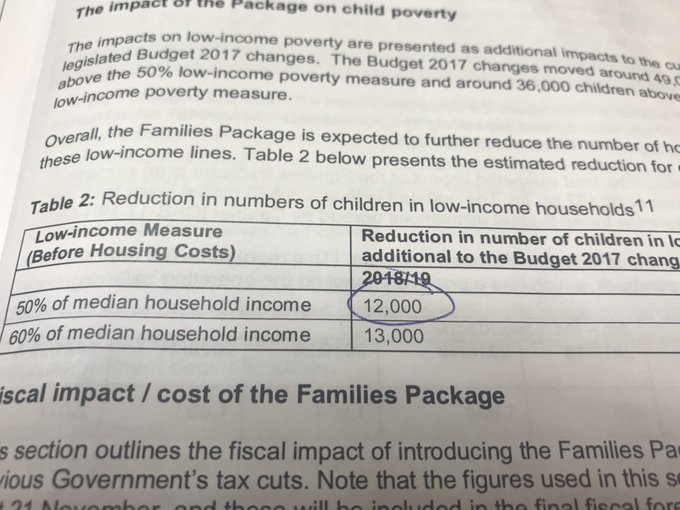
So exactly how many more children are lifted out of poverty versus the 50,000 in National’s package? Grant Robertson told the media 38,000 more – officials say 12,000 in the Disclosure statement. 12,000 is ok but it’s not 38,000


Steve Joyce raises a very good point about the instant claims of rescuing children from poverty:

Labour needs to come clean on exactly how many additional children will be lifted out of poverty with their Families Package, National Party Finance Spokesperson Steven Joyce says.

“Grant Robertson proudly announced yesterday in the Budget Policy Statement that 39,000 more children would be lifted out of poverty than through the previous Government’s package,” Mr Joyce says.

“Yet the independent disclosure statement and Regulatory Impact Statement provided by Government Departments clearly states that only 12,000 more children will be lifted out of poverty through this package.

“This is a concerning difference.

“Asked to explain the discrepancy in Parliament today, the Government simply said that different officials have different views.

“And yet the Regulatory Impact Statement is signed off jointly by Inland Revenue, MSD and Treasury. These are the relevant officials for this package. This is their official view.

“The Government owes the public an explanation.

They trumpeted their numbers loudly yesterday but the numbers in the RIS contradict them.

“Why did they provide their number and why are officials contradicting them?

What is also interesting is changing the method of calculation, moving from 60% of median income to 50%. Labour held the government to account with one measure and now appears to be using a different measure.

But here is another thing the government needs to answer. If, as they claim, they have dramatically improved the lives of children in poverty, with a Grant Robertson speech in parliament and the application of some money coming on stream later on, then why have they left just as many children in poverty?

It’s like there were two kids drowning at the beach and the lifesavers rocked up and saved just one of them. The other is left to drown. That is what Labour has done.

What I’d want to know is who decided and how was it decided to draw an arbitrary line where some kids got left behind by Labour’s new package. Surely, if it was just a matter of applying more money they could have chosen not to borrow $500m to put into the super fund and instead used that to save even more kids.

I think we are seeing the cruel side of Labour, abandoning some children so they can “save” them later. Using children for political gain is low rent, but that is what Labour have done.

No wonder KidsCan is needed, to save those Labour can’t be bothered saving.

Meanwhile, a little girl waits.


-Voxy

If you make lemonade from lemons what do you make from chickpeas and tomatoes?

by SB on December 14, 2017 at 12:30pm


MONIQUE FORD/STUFF
Caroline Herewini, of the Porirua Māori Women’s Refuge, says tinned meat and anything for children’s lunches is more useful than tomatoes or chickpeas. “What are our people going to do with chickpeas?”

It might be the season for giving, but please, no more tinned tomatoes.

These, along with lentils and beans, are some of the items charities would rather do without, however desperate they are for food donations.

Auckland-based refuge charity The Aunties has issued an outright ban on tinned tomatoes, saying they are useless for the women and children it supports. They don’t have the ingredients to go with the food in the first place.[…]

While I totally understand the charity preferring meat and fresh vegetables that require little skill or extra ingredients to turn into a meal I also think that they are missing an opportunity to turn lemons into lemonade.


It is simply a matter of cultural ignorance. Of course, your average Kiwi has no idea what to do with chickpeas as most wouldn’t even know what they are. If they understood that they can be used just like rice and pasta and potatoes then they would see just how useful and versatile they are.

Perhaps the Porirua Māori Women’s refuge should contact Shakti which is the New Zealand refuge for “Asian, African and Middle Eastern women.” I am confident that they would have plenty of ideas of how to turn chickpeas and tinned tomatoes into a filling and tasty meal.

Tomatoes, mince, spaghetti and cheese is a simple and filling meal.


Add a few dried spices, fry some garlic or onion add tomatoes and chickpeas and you have a filling and tasty meal.

Chickpeas take on whatever flavour you want to add to them. They are great in stews, curries or casseroles. Basically, wherever you would usually use pasta, rice or potatoes you can use chickpeas. They are also great in salads.

Maybe she just wants KFC vouchers, If they can’t cook the basics, then takeaways is the only result.

Caroline Herewini, your statement shows the stupidity you have